Survival and racing the clock: how the same decision changes
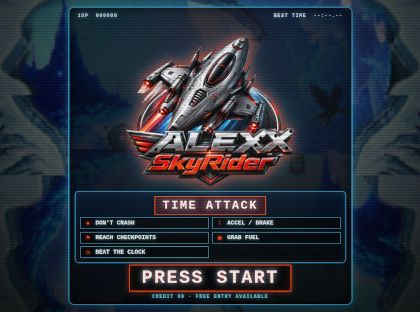
The objective gives movement its meaning
A ship slows down before entering a difficult passage. Seen from outside, the maneuver may look identical in two runs. Its meaning, however, changes with what the player is trying to achieve: preserving the possibility of continuing or completing the route with a better time.
That hypothetical example helps explain why a game mode is not defined solely by its environment. The way the result is evaluated matters too. The same control can serve different priorities without one necessarily being more advanced than the other.
Comparing survival and a race against the clock should begin with that distinction. A survival-focused reading is concerned with keeping continuation viable. A timed reading explicitly includes elapsed time in the evaluation. Both can demand control and attention; what changes is the weight given to each consequence.
Two questions for an opportunity
Suppose an opportunity requires leaving the current trajectory. Before accepting it, the player can consider what it provides and what it demands. If a resource is needed to continue, the detour may address an important need. If there is sufficient margin and the aim is a better time, its effect on the route should also be examined.
It does not follow that one mode encourages collecting everything while the other encourages ignoring it. A timed run can still require resources. A survival-focused run does not make every detour a good choice either. Usefulness depends on the rules and the current situation.
The comparison becomes clearer when the criterion is distinguished from the action:
| Decision | Survival-focused reading | Reading against the clock | |---|---|---| | Change trajectory | Assess whether it helps preserve continuation | Assess its usefulness and its effect on the overall run | | Reduce the pace | Prepare a viable maneuver | Consider the time invested and the possible cost of an error | | Accept a risk | Consider what it could compromise | Also consider what it could add to the final time | | Review the result | Observe where and how continuation was possible | Relate the time to the decisions made during the run |
A time does not explain the whole run
The final time is an outcome, not a complete description of the process. Two attempts can finish with similar times while involving different decisions. A small difference does not, by itself, demonstrate improvement in every aspect of piloting.
To learn from a comparison, it helps to formulate a specific question before playing. For example, whether a more controlled approach allows a passage to be completed more effectively. The outcome can then be read alongside what happened at that point. This is a way of organizing observation, not a guaranteed formula for reducing times.
Separating the aim of an exercise also helps avoid unclear expectations. Practicing a maneuver and seeking the best time are related tasks, but a session can prioritize the former without immediately producing the latter.
Two modes of the first ALEXX SkyRider™
Arcade Principal and Time Attack belong to the first ALEXX SkyRider™. The Journal describes the former's five-Face journey and the latter's use of the clock; it also explains that, in Time Attack, time continues running and collisions affect the outcome. [T24a]
The comparison offers a way to study how a decision is evaluated within the same project. Preparing the ship for the next section remains important. In Time Attack, that preparation must also be related to the time it consumes and the consequences of a poor approach.
The available demos have specific conditions: two bridges and unlimited ships, in Snow / Arctic for Arcade Principal and Night for Time Attack. [T24b] They introduce piloting; their conditions should not be confused with all the rules of the complete modes.
ALEXX SkyRider™ offers two contexts for evaluating a maneuver. In Arcade Principal, pilots can examine how they preserve continuity along the route and manage resources. In Time Attack, they also need to connect the action with the final time. Choosing an objective makes the result easier to interpret: acceleration, braking, or a detour gains meaning through what it helps achieve within that run.
Sources
- T24a: Project documentation — Portal · Why Time Attack became a place to practise
- T24b: Project documentation — Portal