Galaga: more firepower, more space to protect
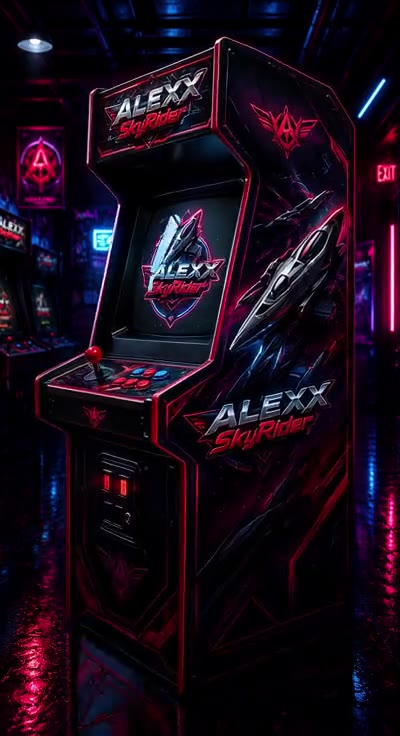
An upgrade with two sides
A more powerful ship appears to be an easy advantage to interpret. It can remove threats with greater attacking capacity and open opportunities that previously seemed difficult. An upgrade, however, can also change what the player needs to protect. Galaga offers a concrete example of that double reading.
Namco released the arcade game in 1981 as a successor to Galaxian. The player moves the ship laterally and fires at enemies that enter in formation and develop different flight patterns. A boss can capture it with a tractor beam; rescuing it allows a dual fighter to form, with greater firepower and a larger size. [L1]
The advantage is therefore not limited to adding shots. It also changes the space occupied by the player. The attacking tool and the defensive situation change together.
A decision that emerged during design
In Bandai Namco’s official interview, Shigeru Yokoyama recalled first considering returning the rescued ship to the reserve of lives before proposing that it join the active ship. He also remembered that, in the tests he describes, participants avoided the dual fighter because a single ship had a smaller collision area and let them survive longer. [L2]
The account offers a view of the feature through the work of design. An idea can be striking and still need evaluation within a run. The question is not simply whether the upgrade produces a visible effect, but which decisions it introduces and under what circumstances it provides value.
Yokoyama connected the challenging stages with the usefulness of the dual fighter. [L2] His account shows that a feature need not be evaluated in isolation: the context in which it is used also contributes to its interest.
Power is different from comfort
An interpretation of Galaga's rules invites a distinction between attacking capacity and room for survival. Greater power can be useful, but does not automatically answer every problem. If positioning still matters, the player must adapt movement to the ship's condition.
This reading avoids reducing a run to a ladder on which every increase represents absolute superiority. A benefit can come with a different demand. Understanding that allows an upgrade to be seen as a decision about the playing experience, as well as a reward.
There is no need to conclude that one ship is always better than two, or the reverse. The example's value lies in recognizing what changes and what still needs to be addressed.
Choosing an opportunity in ALEXX SkyRider™
The first ALEXX SkyRider™ presents a different kind of choice along its downward route. Approaching blue Fuel can restore energy, while contact with red TNT causes an explosion and costs a life, according to its documentation. An opportunity must be read alongside the trajectory needed to reach it.
The comparison does not equate Fuel with Galaga's dual fighter. In one case, the player's configuration changes; in the other, a maneuver to obtain a resource is assessed. Their connection lies in considering the benefit without forgetting its accompanying conditions.
Galaga therefore offers a perspective for examining ALEXX SkyRider™ more carefully: a visible advantage does not remove the need to decide. What it offers, where it appears, and how it changes the next action all matter. The pilot does more than identify opportunities; the pilot also judges which ones are worth taking.
Sources
- L1: galaga.com
- L2: galaga.com