Designing pressure: how threats change decisions
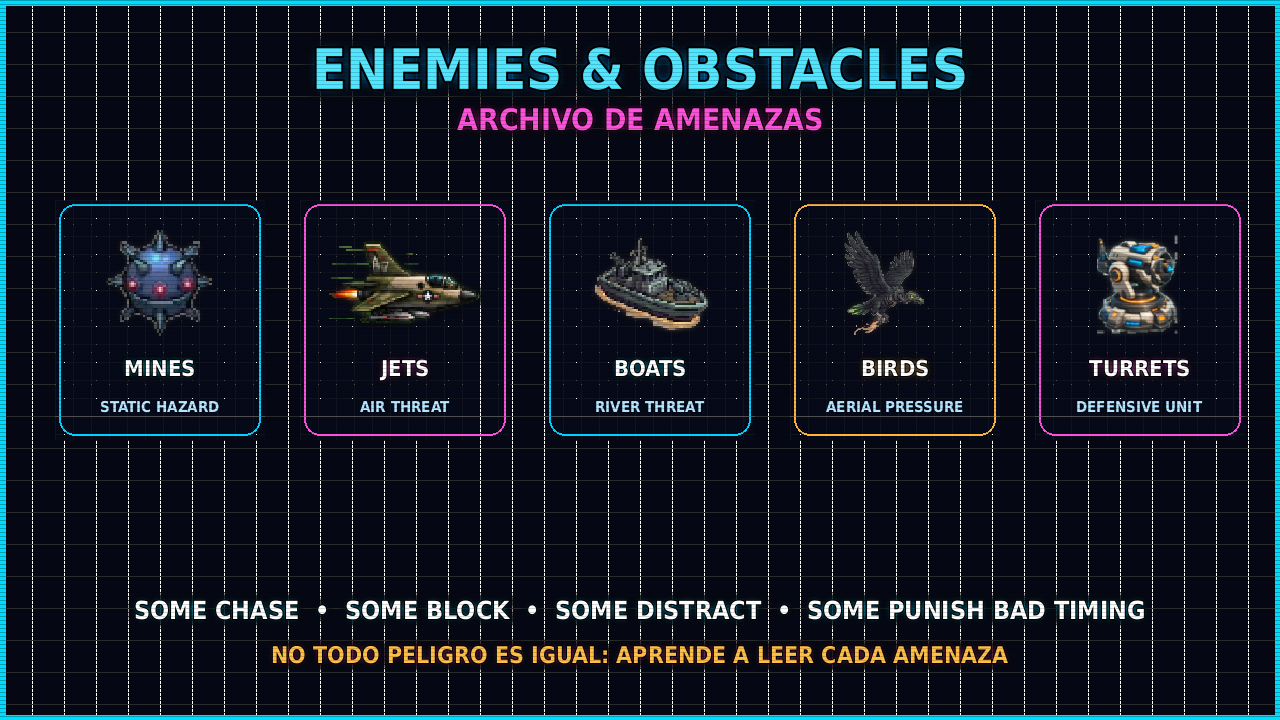
A threat can influence a run before reaching the ship. Its arrival changes the space the pilot intended to use, demands attention, or makes a change of pace necessary. In the ALEXX SkyRider™ Journal, Alejandro describes enemies and obstacles through this relationship with player decisions.
The creative direction sought threats that presented different situations. To examine that intention, it matters to observe what changes when an element enters the scene: the available trajectory, the moment to move, or whether maintaining an attack is worthwhile.
MOVEMENT AS PART OF THE RESPONSE
An airborne threat shares attention with the path developing beneath the ship. Following it requires retaining another reference on the route. If pilots attend only to the target, they may lose sight of the space ahead; if they watch only the terrain, they may stop following a relevant movement.
Defenses associated with the ground introduce another relationship. Their presence and attacks can change whether remaining in an area is desirable. Players need to interpret that situation alongside their position rather than respond to every figure with a single action.
The Gate also distinguishes fixed hazards and moving elements. This classification helps describe the scene, although it does not determine on its own what can be destroyed or how every encounter is resolved. Pressure is understood by connecting a specific threat with the movement it requires.
WHEN SEVERAL NEEDS COINCIDE
A hypothetical example is a Fuel opportunity during an approach with nearby threats. Recovering energy matters, but players also need to prepare the passage and keep track of what moves. The need to choose emerges because actions share time and space.
The scene can be examined through priorities: which condition prevents progress, which can wait, and which maneuver leaves room for the next response. These questions describe an interpretation of the design; they do not establish an identical solution for every encounter.
The same approach makes it possible to discuss difficulty beyond object counts. An opening, an entry position, or the timing of simultaneous threats can change a situation. Comparison needs to preserve those factors to explain why a section calls for another decision.
THE ROLE OF GUARDIANS
The Journal highlights the Yeti and Stone Man as figures that change the character of an encounter. The Gate associates them with Snow/Arctic and Canyon respectively. Their forms place recognizable threats within those Faces’ identities.
According to the Gate, the Yeti attacks with a burst of three projectiles and the Stone Man throws a rock. Each guardian brings together the setting’s identity and a specific threat. The pilot needs to follow the attack while retaining a reference on the ship and the space available for continuing.
In ALEXX SkyRider™, designing pressure means connecting each threat with a piloting response. Players observe what changed, decide what needs resolving, and prepare the continuation. The route becomes interesting when those decisions retain understandable consequences within the action.